Obsidian is dense volcanic glass, usually
rhyolite in composition and typically black in color. Compared with window
glass, obsidian is rich in iron and magnesium; tiny (<.005 mm) crystals
of iron oxide within the glass cause its dark color.
Obsidian is often formed in rhyolite lava flows where the lava cools so
fast that crystals do not have time to grow. Glass, unlike crystals, has
no regular structure and therefore fractures in smooth conchoidal (curved)
shapes. The intersections of these fractures can form edges sharper than
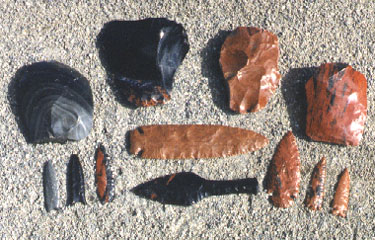
the finest steel blades. For this reason, obsidian was used by many native
cultures to make arrowheads and blades.
More about color of obsidian
The colors in obsidian result from the oxidation state of the chemical
elements within the tiny minerals that are finely dispersed in the glass.
Black color results chiefly from magnetite, Fe304. If the obsidian is
highly oxidized, then the glass may contain hematite, which provides a
reddish hue. Variations in the oxidation state of the iron (Fe) varieties
imparts a slight greenish hue. Some obsidian is banded, a consequence
of oxidation on a flow surface being folded into the lava as it continues
to move.
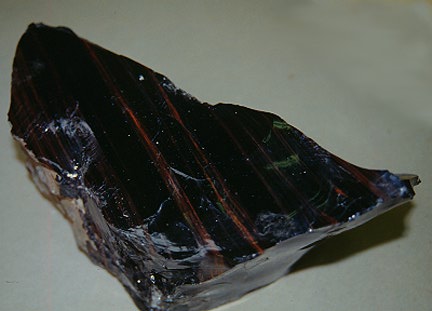
Obsidian is the result of volcanic lava coming in contact with
water. Often the lava pours into a lake or ocean and is cooled quickly.
This process produces a glassy texture in the resulting rock. Iron and
magnesium give the obsidian a dark green to black color. Obsidian has
been used by ancient people as a cutting tool, for weapons, and for ceremonial
purposes and is sometimes found by archaeologists in excavations.
Obsidian has several varieties. Obsidian can contain small bubbles of
air that are aligned along layers created as the molten rock was flowing
just before being cooled. These bubbles can produce interesting effects
such as a golden sheen, known as Sheen Obsidian or a rainbow sheen called
Rainbow Obsidian. Inclusions of small, white, radially clustered crystals
of cristobalite in the black glass produce a blotchy or snowflake pattern
producing Snowflake Obsidian. Small nuggets of obsidian that have been
naturally rounded and smoothed by wind and water are called Apache Tears.
Often confused with smoky quartz, obsidian has similar properties to quartz
because of a similar chemistry. However, many properties dependant on
a crystal structure are altered or absent in obsidian because it lacks
any crystal structure of its own. The piezoelectric and optical properties
in quartz are thus absent in obsidian. Smoky quartz usually has a splotchy
or zoned distribution to its color while Obsidian's color is more uniformly
distributed.
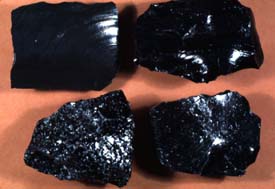
PHYSICAL CHARACTERISTICS:
- Color is dark green to dark brown and black, also can show sheens of gold or green, yellow, blue and/or purple coloration. Sometimes with white inclusions (Snowflake Obsidian).
- Luster is vitreous.
- Transparency: Obsidian is translucent in any stone of appreciable size.
- Crystal System does not apply because obsidian is amorphous.
- Habits include compact nodules or as massive layers between other volcanic rocks
- Fracture is conchoidal.
- Hardness is 5 - 5.5 (much softer than quartz).
- Specific Gravity is approximately 2.6 (average)
- Streak is white.
- Other Characteristics: Generally lacks open voids or large bubbles like other volcanic rocks.
- Notable Occurrences include Italy; Mexico; Scotland; Arizona, Colorado, Texas, Utah and Idaho, USA.
- Best Field Indicators are color, fracture, flow bubbles, softness,
association with other volcanic rocks and lack of crystal faces.